
Klipsch Sub-12
amplifier board — fixed.
The Klipsch Sub-12 shares its BASH plate amplifier and PDC control board with the Sub-10 — and the same weak spot. A dead front panel, a fuse that blows the moment you plug it in, or a sub that no longer wakes up almost always means the amplifier board has failed, not the 12-inch driver.
Is it really the board?
These are the failure patterns we see on the Klipsch Sub-12. Match your symptom before spending a cent.
- No power light, sub appears deadBOARD — WE FIX THIS
The PDC control board (part 660038RA) uses a heat-set adhesive to bond components; after years of heat it carbonizes and turns conductive, shorting the board and damaging the transformer-drive MOSFETs, the inrush thermistor, and often the mains fuse in one event.
- Fuse blows immediately when plugged in, or blows again after replacementBOARD — WE FIX THIS
A fuse that blows again right away means there is a real short on the board — the control-board adhesive fault or a damaged drive MOSFET — not a one-off surge. Replacing the fuse alone will not hold.
- A small transistor near the control board looks browned or overheatedBOARD — WE FIX THIS
The PDC board's bias transistor runs hot in its original small package and visibly discolors with age — an early warning sign before the board fails completely.
- Auto-on stopped working — only plays if music is loudBOARD — WE FIX THIS
Drifted signal-sensing circuitry on the control board. Replacing the plate amplifier restores normal auto-standby behavior.
- Rattling or scraping bassCHECK THE DRIVER FIRST
Mechanical driver damage. Do the flat-hand cone press test before ordering any electronics.
Why the original board fails
Like the Sub-10, the Sub-12 runs its BASH amplifier off a small PDC control board (660038RA) that Klipsch assembled using a heat-set adhesive to bond and dampen components. That adhesive is the design's Achilles' heel: after roughly a decade of standby heat it carbonizes into a mildly conductive residue, bridging traces that should stay isolated. The short cascades outward — taking out the transformer-drive MOSFETs, the inrush-limiting thermistor near the bridge rectifier, and frequently the mains fuse in a single failure event. Most Sub-12s die quietly this way: one day the LED simply never comes on again, or the fuse blows the instant you plug it back in.
Because the enclosure and the 12-inch driver have decades of life left, replacing the plate amplifier is the definitive repair rather than a workaround. Our replacement board matches the original mounting footprint and connectors, with the adhesive-bonded control section rebuilt around properly rated, socketed components instead.
The replacement board
Same footprint, same connectors, no soldering — with the weak spots engineered out.
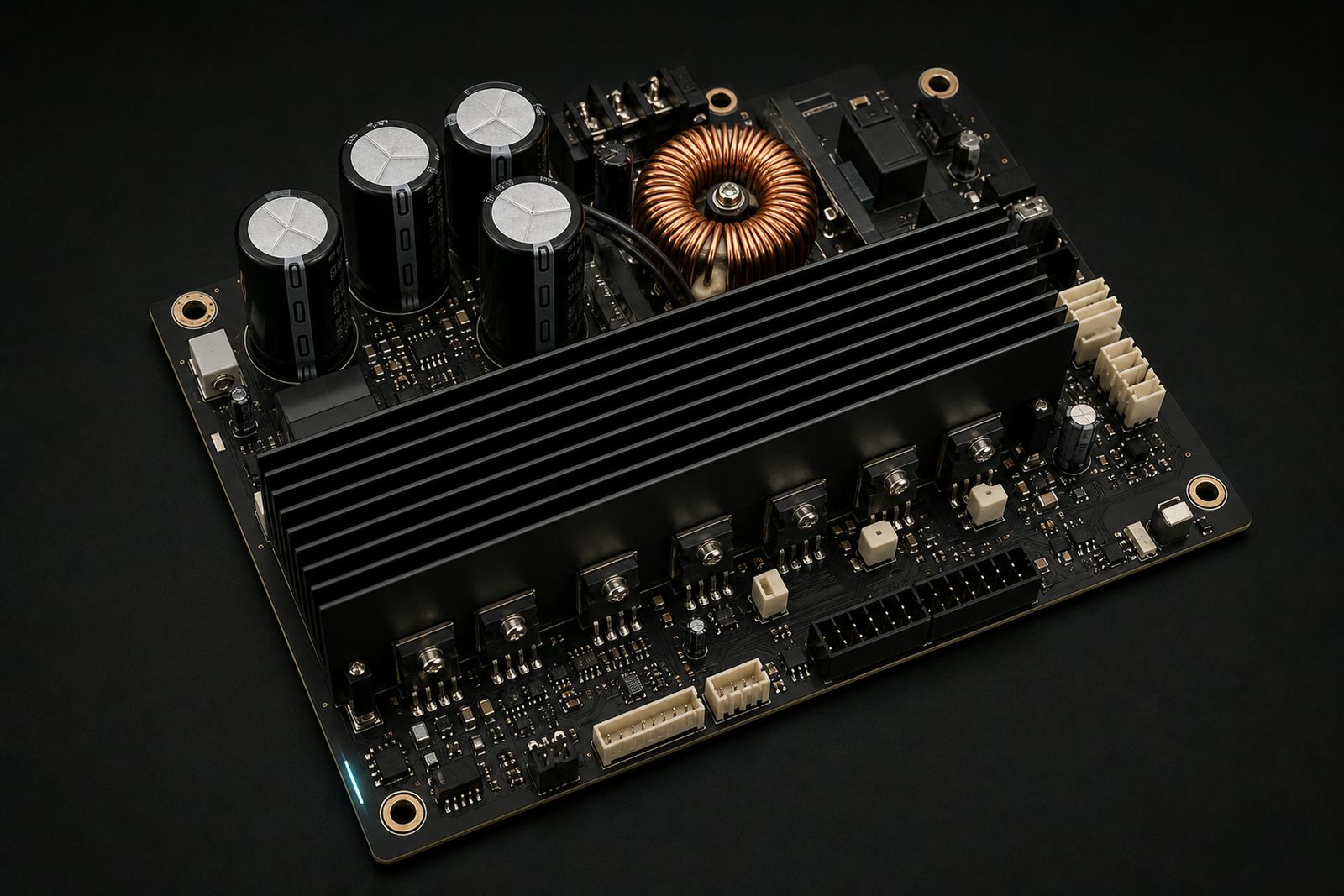
Drop-in replacement plate amplifier for the Klipsch Sub-10 and Sub-12 powered subwoofers. Matches the original mounting footprint, cutout, and connectors — remove screws, unplug, swap, done.
What is improved over the original:
- Standby power supply rebuilt with 105°C long-life capacitors (the original failure point)
- Output stage with proper thermal headroom and protection
- Auto-on signal sensing with a stable threshold
In the box: replacement board, connector guide, illustrated installation instructions. Installation needs a Phillips screwdriver and about 20 minutes — no soldering.
Order — pay after confirmation
No online payment yet: place the order, we confirm stock and shipping to your country by email within 24h, you pay via the link we send. Nothing is charged now.
Questions owners ask
Is this the same board as the Sub-10?
Yes. The Sub-10 and Sub-12 use the same amplifier footprint, the same PDC control board design, and the same connectors — our replacement board fits both models.
My fuse keeps blowing even after I replace it — is that normal?
No, and don't keep feeding it fuses. A fuse that blows again immediately means there is a genuine short on the control board. Continuing to replace the fuse risks further damage.
What tools do I need?
A Phillips screwdriver. The plate amplifier unscrews from the rear panel, the internal connectors unplug by hand, and the new board bolts straight in. About 20 minutes end to end.